



Bhavna S4G, Solar Expert
Last Updated 3 months ago
Trending
Popular
If the above questions have been haunting you and clouding your judgment then this comprehensive blog is just for you.
Here we will cover all the aspects of Sigenergy Sigenstor like its technical details, performance specs, and practical benefits so that you can decide confidently if it’s the right solution for your energy future.
Imagine it’s a cold winter evening. Your street suddenly plunges into darkness, appliances off, boilers idle, EV charging halted. But inside your home, it’s business as usual: the lights are on, heating is running, and your EV continues charging seamlessly. That’s the scenario many homeowners dream of, and it’s precisely what the Sigenergy SigenStor claims to deliver.
Sigenergy, a relatively new but ambitious energy tech company, has designed the SigenStor as a next-generation 5-in-1 battery storage solution. Unlike most batteries that focus purely on energy storage, the SigenStor integrates:
The Sigenergy SigenStor is marketed as the world’s first truly integrated 5-in-1 battery system, designed for both residential and light commercial use. Its purpose is simple: to give users control, flexibility, and resilience in how they consume and store energy.
Unlike traditional setups — where a home might require a separate inverter, separate EV charger, and separate backup switch — the SigenStor combines all these into a single modular stackable unit.
Battery storageThe design is sleek, futuristic, and functional, but what sets it apart is the combination of advanced LiFePO4 battery chemistry, smart energy management algorithms, and DC-coupled EV charging — making it one of the most technically ambitious systems available in 2025.
At its core, the SigenStor is a LiFePO4 (Lithium Iron Phosphate) battery. This chemistry is widely recognised for its:
For perspective, the average UK household consumes 8–10 kWh per day. With a 20 kWh setup, a family could realistically cover a full day’s energy needs without drawing from the grid.
Most battery systems require a separate inverter. The SigenStor eliminates this need with a hybrid inverter built in.
Key inverter details:
This integration reduces installation complexity and ensures direct DC coupling with solar panels, improving efficiency compared to AC-coupled systems.
One of SigenStor’s most unique selling points is the direct DC fast charging for EVs:
This feature alone sets SigenStor apart from competitors, particularly in markets like the UK where EV adoption is rapidly accelerating.
The AI-powered EMS is the “brain” of SigenStor. It includes the following features :
Power cuts are becoming more frequent due to grid strain. The SigenStor is built with seamless backup switching. What it does is that :
The SigenStor’s DC-coupled architecture is its biggest technical advantage. By reducing the number of AC/DC conversions, it minimises energy losses — ensuring more of your solar generation is actually stored and used.
Compared to AC-coupled systems (like Tesla Powerwall 2), SigenStor can deliver up to 10% higher overall system efficiency, especially when charging EVs directly
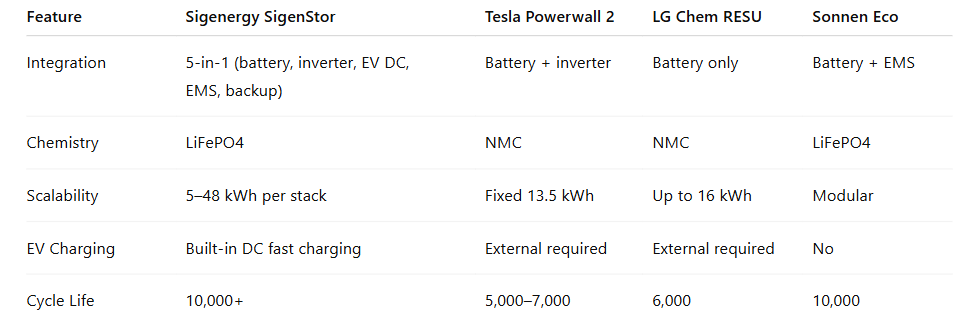
While Tesla dominates in brand awareness, SigenStor outperforms in integration and efficiency.
A clear picture and confident decision won’t be possible unless the pros and cons are considered, Agreed ??
So here we go!
Still wondering If Sigenergystor is for you ? Read on…
If you any of the points below resonate with you then definitely it is for you
The Sigenergy SigenStor is more than just a home battery. It’s an energy ecosystem in one box, offering resilience, efficiency, and future-ready integration for the age of solar and EVs.
For homeowners serious about achieving energy independence — and especially those with EVs — the SigenStor is one of the most innovative and technically advanced options currently available. Explore it today Call our experts
While prices vary by region and configuration, expect it to cost more than basic storage systems like Tesla Powerwall, reflecting its added functions.
Yes. The hybrid inverter supports most common panel setups, both single-phase and three-phase.
Yes, provided your solar capacity and storage are sized appropriately for your household’s energy demands.
Minimal. The LiFePO4 chemistry requires little upkeep, and remote diagnostics via the EMS keep performance optimised.
Very. The modular design and software updates ensure compatibility with future smart grids and tariff structures.